PHP2Shell: Critical Unauthenticated RCE Vulnerabilities & How Kron PAM Limits the Blast Radius When Web Servers Are Compromised
Oct 22, 2026
/
Jeff Hughes
Table of Contents
On October 21, 2026, the PHP project released emergency security updates addressing two critical vulnerabilities that allow unauthenticated remote code execution (RCE). Collectively nicknamed PHP2Shell, these flaws affect the PHP runtime itself and impact virtually every installation that serves web requests. With active exploitation attempts reported even before public disclosure, organizations must patch immediately. At the same time, Privileged Access Management provides an essential layer of defense for the scenarios that inevitably arise when a web server is compromised.
The Vulnerabilities
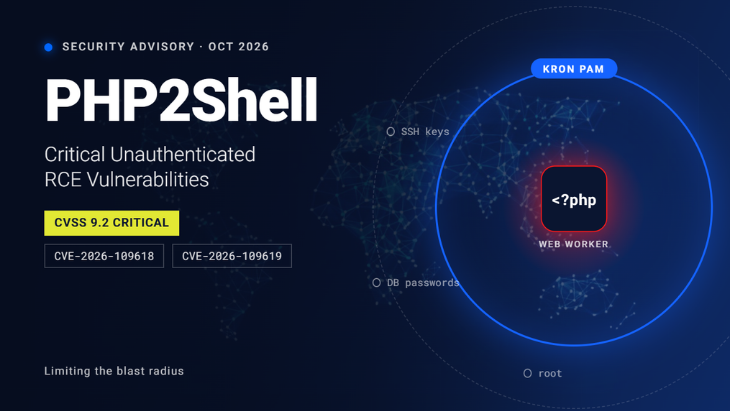
The two flaws, both rated CVSS v4.0 9.2 (Critical), are:
- CVE-2026-109618 (GHSA-w8hw-w9fx-j79w) — RCE via out-of-memory corruption. Out-of-memory handling can interrupt PHP while internal request data is only partially initialized. Subsequent request cleanup may treat the invalid data as valid, enabling code execution.
- CVE-2026-109619 (GHSA-6wmf-4rv5-p3rp) — RCE via stale global state. Request-owned internal state can survive after its backing memory has been freed. A later request handled by the same worker may use that stale state before normal initialization resets it.
Both are memory-safety issues in PHP’s core request processing and interpreter. They are not application-level bugs, meaning even well-written PHP applications are affected. Confirmed impact includes unauthenticated remote code execution as the web worker account. Risk is highest for Apache with mod_php, where a demonstrated exploit can trigger the attack before any application code runs. PHP-FPM, php-cgi, FrankenPHP, and LiteSpeed are also affected.
Who Is Affected and Current Status
All PHP installations serving web requests are at risk, spanning versions from PHP 5 (2004) onward. Official patches are available only for supported branches:
- PHP 8.5 → 8.5.12
- PHP 8.4 → 8.4.27
- PHP 8.3 → 8.3.36
- PHP 8.2 → 8.2.35
PHP 8.1 and earlier are end-of-life and receive no official updates from the PHP project, though minimal source backports were provided for 7.4, 8.0, and 8.1, and some Linux distributions or LTS vendors may offer backports. The PHP security team has stated there are no complete mitigations—updating is the only safe choice. Temporary partial measures (such as setting memory_limit=-1 or disabling session.upload_progress) can reduce exposure to specific attack paths but do not eliminate the risk.
Exploitation activity has been observed. Amazon reported attempts as early as October 17, four days before the patches, and activity increased after details began circulating. Major organizations and government sites have taken systems offline as a precaution where immediate patching was not feasible. Cloudflare and other providers deployed temporary WAF rules.
From Web RCE to Broader Compromise
Successful exploitation grants an attacker code execution under the privileges of the PHP worker process. While this is typically a limited account, it is rarely the end of the attack chain. Common next steps include:
- Harvesting credentials, SSH keys, database passwords, API tokens, or cloud credentials stored on the server or in configuration files.
- Attempting privilege escalation to root or other privileged local accounts.
- Using discovered credentials for lateral movement to other systems, databases, or network devices.
- Establishing persistence, exfiltrating data, or deploying additional malware, including ransomware.
In environments where privileged accounts have standing rights, shared passwords, or weak session controls, a single compromised web server can rapidly expand into a significant breach. This is precisely where Privileged Access Management reduces the attacker’s options.
How Kron PAM Helps Contain and Respond
Kron PAM is a unified Privileged Access Management platform that secures, controls, and audits privileged access across servers, network devices, databases, and cloud environments. While it does not replace the need to patch PHP, it significantly limits the value of a compromised web-worker account and provides the visibility and control required for effective incident response.
Password Vault: Remove Standing Secrets
Kron PAM’s Password Vault centralizes privileged credentials in an encrypted vault. Users check out credentials for specific tasks rather than relying on passwords stored on servers or shared among teams. Key capabilities include:
- Automatic generation and regular rotation of strong, unique passwords for local, service, and application accounts.
- Just-in-time checkout with optional multi-level approvals, so credentials are not persistently available on the server.
- Full audit trails of who checked out which credential, when, and for how long.
- Support for storing SSH keys, certificates, and other secrets alongside passwords.
Even if an attacker obtains code execution on a web server, the absence of reusable privileged credentials dramatically reduces the opportunity for lateral movement or further compromise.
Privileged Session Manager: Visibility and Control
The Privileged Session Manager acts as an agentless gateway for administrative sessions (SSH, RDP, Telnet, and more). All privileged activity is mediated, monitored, and recorded:
- VCR-like session recordings and comprehensive command logging for forensic analysis.
- Real-time monitoring with “four-eyes” dual control—supervisors can watch, message, take over, or terminate sessions.
- Policy-based command filtering, approval workflows for high-risk actions, time-based restrictions, and geofencing.
- Integration with SIEM and behavioral analytics to flag anomalous activity.
If an attacker attempts to use a compromised account or stolen credentials to access other systems, those sessions are fully visible and controllable, enabling rapid detection and containment.
Least Privilege and Just-in-Time Access
Kron PAM enforces least privilege through several mechanisms:
- Endpoint Privilege Management that eliminates standing local administrator rights in favor of temporary, approved elevation.
- Just-in-Time (JIT) access workflows where privileges are requested, approved, time-bound, and automatically revoked.
- Fine-grained command and application policies, segregation of duties, and multi-level approvals for sensitive operations.
- Unified Access Manager for TACACS+ / RADIUS environments, extending centralized policy and logging to network infrastructure.
These controls ensure that even valid privileged accounts cannot be freely abused, and temporary access required for incident response or patching is tightly governed.
Additional Layers: MFA, Analytics, and Database Controls
Kron PAM further strengthens the environment with:
- Multi-Factor Authentication (including push, TOTP, and FIDO2) for both the PAM console and target systems, reducing the usefulness of stolen passwords.
- AI-powered User Behavior Analytics that detects anomalous privileged activity and can trigger alerts or automated responses.
- Database Access Manager with dynamic data masking, providing the same session control and auditing for database administrators and applications.
Recommended Immediate Actions
- Patch PHP immediately. Upgrade all supported installations to PHP 8.5.12, 8.4.27, 8.3.36, or 8.2.35. For end-of-life versions, plan an upgrade or confirm vendor backports.
- Assess exposure. Inventory internet-facing PHP systems, identify mod_php deployments (highest risk), and check for signs of prior compromise.
- Apply temporary mitigations only where necessary. Follow PHP’s guidance while preparing permanent updates, and monitor for exploitation attempts.
- Review privileged access posture. Ensure credentials are vaulted, sessions are monitored, standing privileges are minimized, and MFA is enforced on administrative access.
- Prepare incident response playbooks. Leverage session recordings and audit logs for rapid investigation if compromise is suspected.
Conclusion
PHP2Shell represents one of the most serious and widely impactful vulnerabilities disclosed in recent years. Because the flaws reside in the PHP runtime and affect a language that powers a substantial portion of the web, the potential blast radius is enormous. Immediate patching is non-negotiable.
At the same time, organizations that have already implemented strong Privileged Access Management are better positioned both to limit the damage from any successful exploitation and to respond effectively. Kron PAM’s combination of credential vaulting, session control, least-privilege enforcement, multi-factor authentication, and behavioral analytics turns a compromised web-worker process into a far more contained event rather than the starting point of a major breach.
In an environment where critical vulnerabilities can emerge with little notice and active exploitation can begin within hours, layered controls around privileged access remain one of the most effective ways to reduce organizational risk.
For more information on Kron PAM or to request a demonstration contact us.