
















Kron Recognized as a Leader in 3 Categories and a Challenger in 1 Category by KuppingerCole Analysts!
Download Report
Discover Everything, Miss Nothing: Device & Account Discovery in Kron PAM

Discover Everything, Miss Nothing: Device & Account Discovery in Kron PAM

Apr 30, 2026 / Erhan YILMAZ

In modern IT environments, visibility is everything. Yet as infrastructures expand across data centers, cloud networks, and hybrid environments, gaining a complete and up-to-date inventory of devices and privileged accounts becomes increasingly difficult.

Kron PAM addresses this challenge with advanced discovery capabilities designed specifically for network infrastructures—giving security teams and system administrators continuous insight, control, and confidence.

Flexible Onboarding for Network Devices

Every organization manages its infrastructure differently, which is why Kron PAM supports multiple ways to bring devices under management. System administrators can add devices manually, import them from Active Directory or LDAP services, synchronize from a CMDB, or perform bulk imports using Excel files.

Beyond these traditional methods, Kron PAM enables active discovery by scanning network subnets. This approach ensures that even devices not documented in existing systems are identified and evaluated—closing gaps that are often exploited by attackers.

Active Network Discovery Through Subnet Scanning

Subnet-based discovery in Kron PAM allows administrators to define one or more network ranges and associate them with specific device groups. These subnets can represent a single environment or span multiple segments across the organization.

Once configured, Kron PAM scans these networks to identify reachable devices and determine whether they should be managed as part of the privileged access environment. This proactive approach helps organizations maintain an accurate inventory, even as networks continuously change.

Discovery Profiles Designed for Network Infrastructure

Discovery in Kron PAM is driven by configurable discovery profiles, giving administrators precise control over how scanning is performed. Within a profile, admins select the protocol to be used—such as SSH, Telnet, SNMP, or RDP—and define which types of network elements should be identified.

Discovery profiles can be executed manually when immediate insight is required or scheduled to run periodically. This ensures visibility is maintained over time without adding operational burden to system administrators.

Visibility and Insights Through the Discovery Dashboard

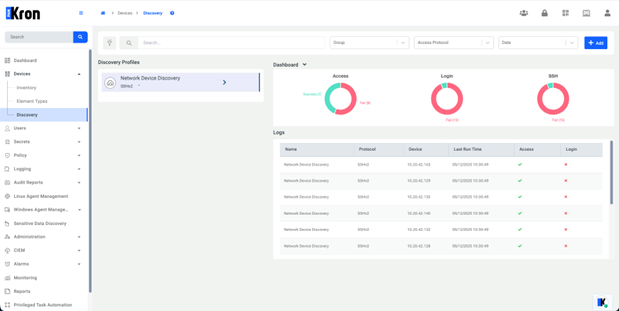
When a subnet discovery is completed, results are presented in the Discovery Dashboard. From a single view, administrators can see how many devices were scanned, how many responded to the specified ports, and how many Kron PAM successfully authenticated to retrieve detailed information.

This level of transparency allows teams to quickly assess the state of their network, spot connectivity or access issues, and make informed decisions about onboarding and remediation.

discover-everything-miss-nothing-device-account-discovery-in-kron-pam_1

Local Account Discovery Beyond the Device Level

Discovery does not stop identifying devices. Unmanaged local accounts on network infrastructure are a common source of risk, particularly in environments where shared or legacy credentials still exist.

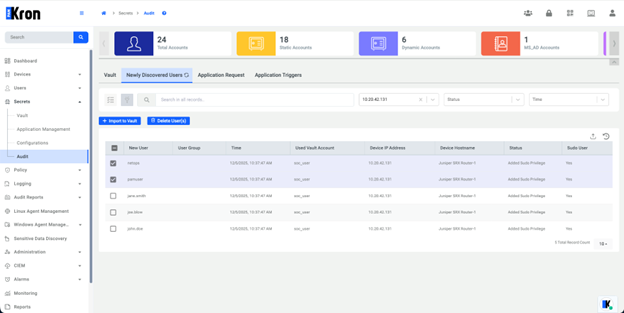
Kron PAM integrates device discovery with its Password Vault to continuously scan managed devices for local user accounts. These scans run automatically at defined intervals, and authorized users can also trigger them manually when needed. Any newly discovered accounts are flagged for review, ensuring administrators are always aware of changes at the access level.

discover-everything-miss-nothing-device-account-discovery-in-kron-pam_2


Automated Response with Full Administrative Control

Once local accounts are discovered, Kron PAM helps organizations respond quickly and consistently. Depending on policy, unauthorized accounts can be deleted automatically; notifications can be sent to administrators, or accounts can be reviewed and selectively imported into the Password Vault.

This combination of automation and control allows security teams to reduce risk without sacrificing operational flexibility.

Why Discovery Is Critical for Network PAM

Network devices often fall outside the scope of traditional identity and endpoint security solutions, creating dangerous blind spots. Kron PAM eliminates these gaps by unifying network discovery, credential visibility, and account governance into a single platform.

By continuously discovering both devices and privileged accounts, Kron PAM helps organizations gain a stronger security posture, improve compliance, and significantly reduce the attack surface across their network infrastructure.

Final Thoughts

You cannot secure what you cannot see. With its advanced discovery capabilities, Kron PAM ensures that every device and every privileged account in the network is visible, controlled, and protected.

Discovery is not just a feature—it’s the foundation of effective network security. And with Kron PAM, that foundation is always up-to-date.

*Written by Erhan YILMAZ. He is the Director of PAM Product Management at Kron.

FAQ's

Kron PAM scans network subnets and identifies any reachable device within the defined IP ranges — routers, switches, servers, and other network infrastructure elements. The discovery profile determines which protocols are used during scanning (SSH, Telnet, SNMP, RDP, and others), so the scope adapts to whatever your environment runs.

No. A single discovery profile can cover multiple subnets and span different network segments. You can associate those subnets with specific device groups, which makes organizing large or segmented environments much more manageable.

That depends on your configuration. Scans can be scheduled to run at defined intervals automatically, or triggered manually when you need immediate results — say, after a network change or a new deployment. Most teams do both: scheduled scans for continuous coverage, manual runs when something specific comes up.

It shows up in the Discovery Dashboard flagged for review. Administrators can then decide whether to onboard it, ignore it, or investigate further. Nothing gets added to the managed environment automatically without a deliberate action — you stay in control of what gets managed.

Yes, and this is one of the more important pieces. After a device is brought under management, Kron PAM continues scanning it for local user accounts. These scans run on a schedule and can also be triggered manually. Any accounts that weren't previously tracked get flagged, so you're not left with unmanaged credentials sitting quietly on managed devices.

Depending on your policy, a few things: the account can be deleted automatically, an alert can be sent to the administrator for manual review, or the account can be imported into the Password Vault and brought under proper management. You set the rules; Kron PAM enforces them consistently.

It does. Kron PAM can import devices directly from Active Directory, LDAP, and CMDB integrations, and also supports bulk imports via Excel. Active subnet scanning sits on top of those methods — it's designed to catch whatever those systems miss, not replace them.

Most compliance frameworks — whether that's ISO 27001, PCI DSS, NIST, or others — require organizations to maintain an accurate inventory of privileged accounts and the systems they access. Continuous discovery means that inventory stays current without relying on manual processes, which is exactly the kind of evidence auditors look for.